
INTRO Why Print Size Matters
A print that's too large overwhelms the garment. Too small, and it looks like an afterthought. Getting sizing right is what separates a professional custom apparel result from one that looks off — and with DTF printing, you have full control over every dimension.
This guide gives you the exact measurements used by professional apparel decorators for every major placement location — chest, back, sleeve, left chest logo, and all hat positions.
Always size your print relative to the garment. A 12-inch wide print looks perfect on an XL adult tee but will overwhelm a youth small. Scale proportionally to the shirt size whenever possible.
01 T-Shirts, Hoodies & Sweatshirts
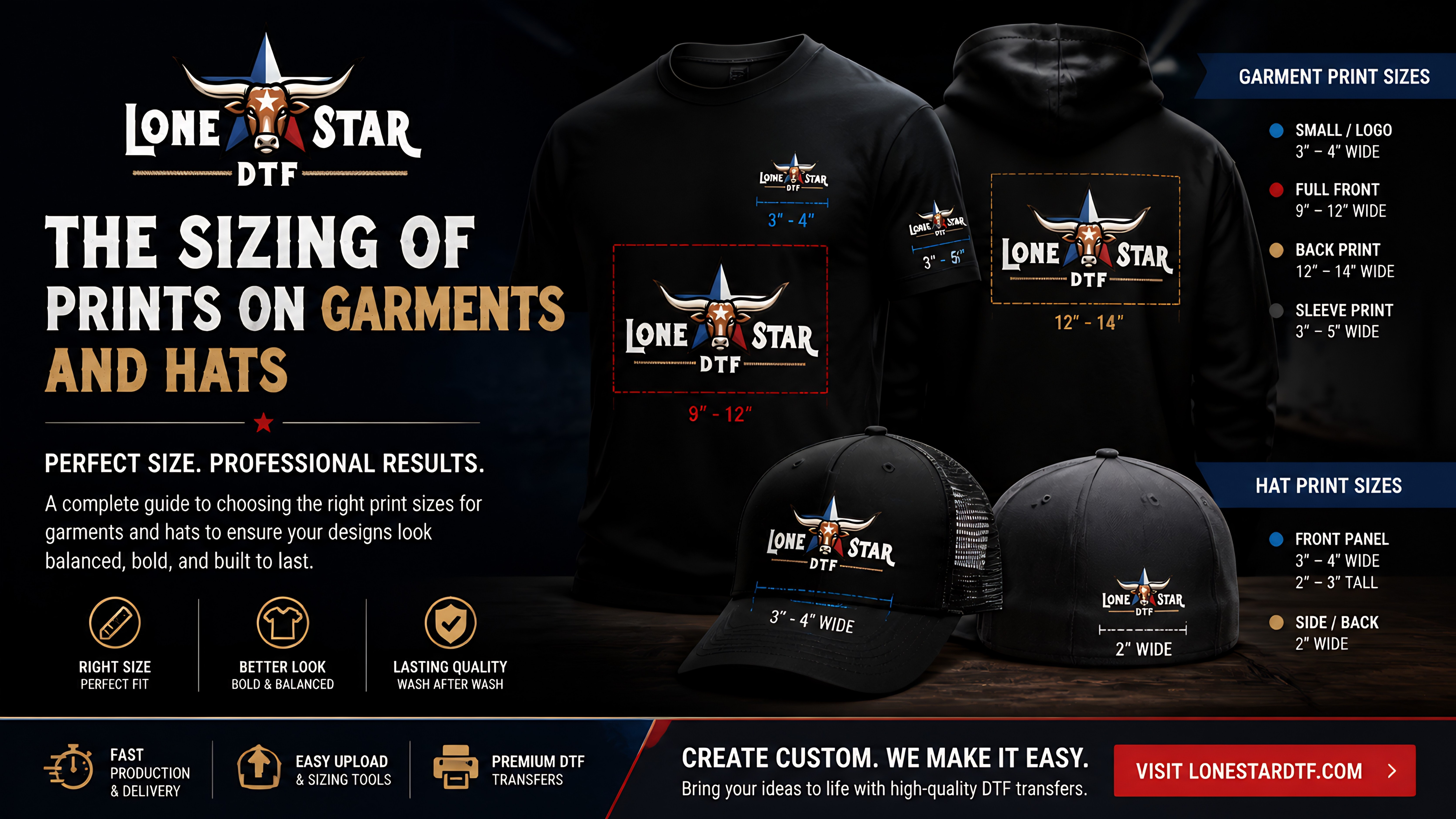
Garments are the most common DTF printing surface. Here are the standard sizing guidelines for each placement location on adult apparel:
02 Sizing by Garment Size (Adult & Youth)
Print sizes should scale with the garment size. Here's a reference table for both adult and youth apparel across the most common placement types:
| Garment Size | Left Chest Logo | Full Front | Back Print | Sleeve |
|---|---|---|---|---|
| Youth XS / S | 2″ – 3″ | 7″ – 9″ | 9″ – 11″ | 2″ – 3″ |
| Youth M / L | 2.5″ – 3.5″ | 8″ – 10″ | 10″ – 12″ | 2.5″ – 3.5″ |
| Adult S / M | 3″ – 4″ | 10″ – 11″ | 11″ – 12″ | 3″ – 4″ |
| Adult L / XL | 3.5″ – 4″ | 11″ – 12″ | 12″ – 13″ | 3.5″ – 5″ |
| Adult 2XL+ | 4″ – 4.5″ | 12″ – 14″ | 13″ – 14″ | 4″ – 5″ |
| Oversized / Streetwear | 4″ – 5″ | 13″ – 15″ | 13″ – 15″ | 4″ – 6″ |
Fitted shirts need proportionally smaller prints to maintain visual balance. Oversized or streetwear-style garments can carry larger, bolder designs — a full-front 14-inch print looks intentional on a boxy fit but overwhelming on a fitted cut.
03 Hat & Cap Print Sizing
Headwear has significantly less surface area than a garment, so sizing is critical. Too large and the design bleeds off the panel — too small and it becomes illegible. Here are the recommended sizes by hat style and placement:
Structured Cap / Snapback
Front panel print. Most common hat style — enough room for a clean logo with legible text.
Trucker Cap
Larger foam front panel allows slightly bigger designs. Great for detailed logos.
Dad Hat / Unstructured
Softer, curved front. Keep designs simple and compact — complex graphics can distort.
Beanie
Minimal surface area. Small, simple designs only — a single word or basic icon works best.
Side Panel Print
Side prints on any hat style. Keep compact — this is a secondary accent, not the main design.
Back Strap / Patch
URL, small logo, or slogan. Very limited space — text should be 0.5″ tall minimum for legibility.
Always test your hat print on the actual hat before ordering a batch. The curved surface of a hat can make a flat design appear distorted — order a sample transfer first and check placement before committing to a full run.
04 Print Placement Tips
Sizing is only half the equation — placement determines whether a design looks intentional or sloppy. Here are the professional standards:
Chest Print Placement
Center chest prints should sit 3–4 inches below the collar. For left chest logos, align to the left side of the chest, roughly over the heart.
Back Print Placement
Back prints typically start 3–4 inches below the collar seam. Center horizontally. For names above numbers, leave 0.5–1 inch of gap between them.
Sleeve Placement
Sleeve prints look best centered on the outer arm, starting 1–2 inches below the shoulder seam. Avoid wrapping around the seam line.
Hat Centering
Center your hat design horizontally on the front panel. Vertically, aim for the center of the panel or slightly above center for visual balance.
Know Your Audience
Younger audiences often prefer bolder, larger prints. Professional or corporate apparel typically uses smaller, more refined logo placements.
Always Order a Sample
Before printing a full batch, order one sample transfer. Verify the size and placement looks right on the actual garment or hat before committing.
FAQ Frequently Asked Questions
For adult t-shirts, a standard chest print is 10–12 inches wide. Full-front designs work best at 12–14 inches wide. Left chest logo prints are typically 3–4 inches wide. Back prints are usually 12–14 inches wide for adult sizes.
For most caps and snapbacks, a front panel print should be 3–4 inches wide and 2–3 inches tall. Trucker caps can go slightly larger at 3.5–4.5 inches wide. Side or back prints should be around 2 inches wide to maintain balance.
Sleeve prints typically range from 3–5 inches. Keep sleeve designs subtle and balanced — they are accent prints and don't need to be large to make an impact. Avoid designs that wrap around the sleeve seam.
Yes. Youth garments require proportionally smaller prints. A full-front print on a youth shirt is typically 7–9 inches wide, compared to 12–14 inches for adults. Always scale your design relative to the garment size to maintain visual balance.
Ready to Get Your Sizing Right?
Upload your design to LoneStar DTF and get vibrant, perfectly sized custom transfers — same-day printing available, no minimums.