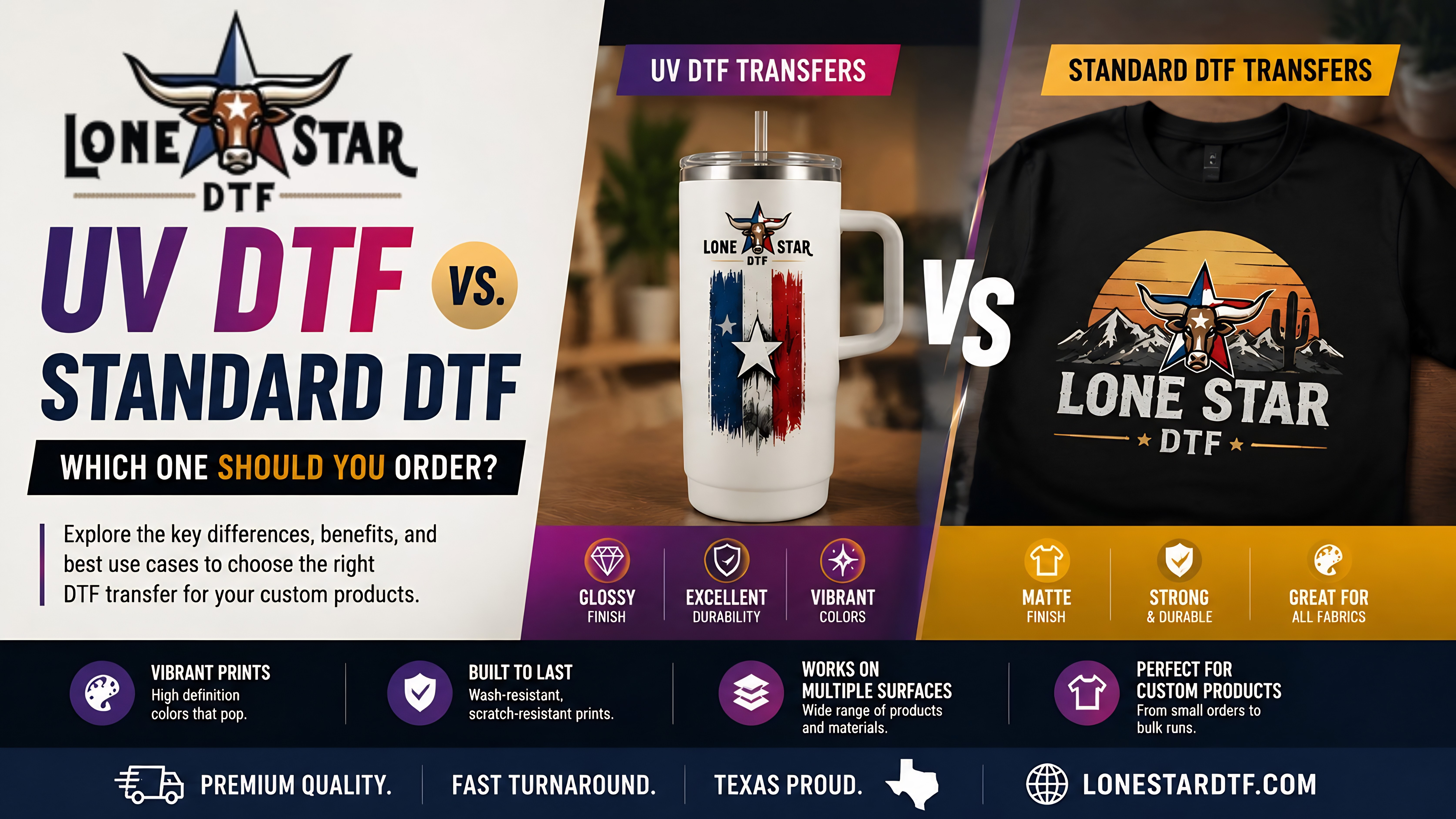

The term "DTF" gets used loosely — and that creates real confusion when you're trying to order custom printing. UV DTF and standard DTF are fundamentally different products designed for completely different surfaces. Ordering the wrong one for your project is a costly mistake.
Here's the straightforward breakdown: Standard DTF transfers go on fabric. UV DTF transfers go on hard surfaces. Everything else — finish, durability, cost, application method — flows from that core difference. Let's dig into what each one actually is and when you should use it.
IMPORTANT The Most Important Thing to Know First
UV DTF transfers are NOT applied with a heat press and do NOT go on fabric apparel. They are designed for hard, smooth, non-porous surfaces — mugs, tumblers, phone cases, acrylic, glass, and wood. If you want custom t-shirts, hoodies, or hats, you want Standard DTF transfers. Mixing these up is the #1 mistake customers make.
OVERVIEW What Each Method Actually Is
A design is printed onto transfer film using expanded gamut CMYK+RGBO+White inks, then heat-pressed onto fabric with a heat press. The result is a vibrant, soft, wash-fast print that bonds with fabric fibers.
Ink is cured with ultraviolet light, creating a transfer that sticks to smooth, hard, non-porous surfaces using pressure alone — no heat press required. Produces a glossy, scratch-resistant finish.
STANDARD DTF Standard DTF Transfers — The Apparel Standard
Standard DTF is what LoneStar DTF specializes in — and what the vast majority of custom apparel printing uses. It's the method behind every vibrant custom t-shirt, hoodie, jersey, and hat you see produced with full-color, photographic-quality detail.
- Works on virtually any fabric type
- Unlimited colors — no color surcharges
- Soft, flexible feel that moves with fabric
- Highly durable — wash-fast for many cycles
- No minimums, no setup fees
- Same-day turnaround available
- Works on dark and light fabrics
- Requires a heat press to apply
- Does not work on hard surfaces
- Matte finish (not glossy)
Custom t-shirts, hoodies, sweatshirts, hats, tote bags, performance jerseys, youth sports uniforms, event merchandise, business uniforms, and any fabric-based custom apparel. This is what you want for 95% of custom printing projects.
UV DTF UV DTF Transfers — The Hard Surface Specialist
UV DTF transfers are a completely different technology that excels where standard DTF cannot go — smooth, hard, non-porous surfaces. The UV curing process creates a transfer that adheres with pressure alone, delivering a glossy, scratch-resistant finish on drinkware, phone cases, acrylic, and more.
- Glossy, premium finish that pops visually
- Scratch-resistant and highly durable on hard surfaces
- No heat press needed — apply with hand pressure
- Excellent color vibrancy on dark surfaces
- Works on surfaces standard DTF cannot
- Great for drinkware, merch bundles, & gifts
- Does NOT work on fabric apparel
- Requires a smooth, non-porous surface
- Slightly higher cost than standard DTF
- Not wash-machine safe on some surfaces
Custom drinkware (mugs, tumblers, water bottles), phone cases, acrylic signs, glass, wood plaques, metal items, plastic merchandise, and any smooth hard surface. Perfect for adding custom branding to non-apparel merchandise.
FINISH The Look & Feel Difference
One of the most visible differences between the two methods is the finish they produce:
COMPARE Full Side-by-Side Comparison
| ☀️ UV DTF | 🔥 Standard DTF | |
|---|---|---|
| Primary Use | Hard surfaces — mugs, cases, acrylic | Fabric apparel — shirts, hoodies, hats Most Common |
| Application Method | Pressure only — no heat press needed | Heat press required (280–330°F) |
| Finish | Glossy, raised, vibrant Premium Look | Matte, soft, fabric-integrated |
| Works on Fabric | No — designed for hard surfaces only | Yes — any fabric type Winner |
| Works on Hard Surfaces | Yes — mugs, glass, acrylic, metal, wood Winner | No — fabric only |
| Scratch Resistance | High — UV cured for hardness | Standard — designed for fabric flex |
| Dark Surface Vibrancy | Excellent — especially on dark drinkware | Excellent — white ink base layer |
| Cost vs. Standard DTF | Slightly higher | Most affordable option Winner |
| No Minimums | Yes | Yes |
| Same-Day Available | Yes | Yes |
USE CASES Which Method for Which Project?
Here's a practical guide to which transfer type fits each common project type:
Custom T-Shirts & Hoodies
Fabric apparel of any kind — event shirts, uniforms, business merch, sports jerseys.
Standard DTFCustom Mugs & Tumblers
Branded drinkware, event keepsakes, personalized gift mugs and water bottles.
UV DTFCustom Hats & Caps
Snapbacks, dad hats, trucker caps — any headwear with fabric panels.
Standard DTFCustom Phone Cases
Branded phone cases, personalized cases, event giveaway accessories.
UV DTFSports Team Uniforms
Performance jerseys, athletic wear, team uniforms — any sports fabric.
Standard DTFCustom Signs & Plaques
Acrylic signs, wood plaques, branded signage, award plaques.
UV DTFTote Bags & Fabric Accessories
Canvas tote bags, fabric bags, aprons, any textile-based accessory.
Standard DTFGift Bundles (Shirt + Mug)
Custom gift sets combining fabric apparel with branded drinkware or accessories.
Standard DTF + UV DTFVERDICT Which Should You Order?
★ What Customers Say
"I ordered UV DTF for our branded tumblers and Standard DTF for the matching shirts. LoneStar DTF handled both perfectly. The mug wrap looks incredible — glossy and sharp. The shirts are soft and vibrant. Perfect gift bundle."
"I was confused about which to order for our event. Called LoneStar and they explained it perfectly — Standard DTF for the shirts, UV DTF for the custom cups. Turnaround was same day. Quality was spot on."
FAQ Frequently Asked Questions
Standard DTF transfers are heat-pressed onto fabric using a heat press. UV DTF transfers use ultraviolet light to cure the ink, creating a glossy, scratch-resistant finish for hard surfaces like mugs, phone cases, and drinkware. Standard DTF is for fabric apparel; UV DTF is for rigid surfaces.
No. UV DTF is designed for hard, non-porous surfaces like drinkware, acrylic, glass, and plastic. For fabric apparel like t-shirts and hoodies, standard DTF transfers are the correct choice.
Standard DTF transfers are generally more cost-effective for apparel printing, with no minimums and no setup fees. UV DTF transfers cost slightly more due to the UV curing process, but offer unique value for hard surface customization that standard DTF cannot do.
UV DTF transfers work on hard, smooth surfaces including drinkware (mugs, tumblers, water bottles), phone cases, acrylic, glass, wood, metal, leather, and plastic. They do not require a heat press — the transfer adheres with hand pressure.
Yes. LoneStar DTF offers both standard DTF transfers for apparel and UV DTF transfers for hard surface customization. Contact us to discuss your project and we will recommend the right method for your specific needs.
Not Sure Which to Order?
Contact LoneStar DTF — we'll recommend the right transfer type for your specific project. Same-day printing, no minimums.